
Programming is constructed on repetition, logic and structure. The for loop is the most powerful and most widely used tool of the developer of all the looping constructs in Java. It doesn’t matter whether you are looping over arrays, computing values, working on strings or writing server-side applications, in order to write clean and efficient code, you must understand how the for loop functions.
With this reference guide, we shall discuss:
* What a for loop in Java is
* How for loop java works internally.
Arrays and strings Practical examples.
* Its relation to the length of the strings in Java.
* Looping in server-side procedures.
* JavaScript sleep and Java.
* Writing a basic productivity calculator.
Performance tips and best practices.
Ten frequent questions and their answers.
Let’s begin.
### What is a for Loop in Java?
A for statement is a control statement used to repeat the code within a block until a given condition is met.
**Basic Syntax**
“`java
(initialization; condition; update) for
// code block
}
“`
**Explanation**
* **Initialization**- Executes once prior to the initiation of the loop.
* **Condition** -verified at each iteration; is used to decide whether the loop is to propagate.
* **Update** – This is performed at the end of each iteration, and is normally done to adjust the loop variable | watermark remover
The For Loop has an internal mechanism that works in the following manner.
1. **Initialization** runs.
2. The **condition** is examined.
3. In case this is true the loop body is executed.
4. The **update** runs.
5. Once more the condition is examined.
The evaluation is repeated to a point when the condition becomes false. This is a distinct pattern that renders the for loop to be the best to count the iterations.
### Basic Example of a For Loop
“`java
for (int i = 0; i < 5; i++) {
System.out.println(i):iteration);
}
“`
**Output**
“`
Iteration: 0
Iteration: 1
Iteration: 2
Iteration: 3
Iteration: 4
“`
The loop is repeated five times since i begins at 0 and it goes on until i is less than 5.
### Using a For Loop with Arrays
The use of loops is often due to arrays.
“`java
int[] numbers = {10, 20, 30, 40};
for (int i = 0; i < numbers.length; i++) {
System.out.println(numbers[i]);
}
“`
The length of numbers is used to make sure that the loop is run as many times as the number of elements in the array.
Java has significantly advanced, and now it is possible to understand the string length using a For Loop.
In the case of strings, a method called length gives the number of characters in a given string.
**Example**
“`java
String name = “Java”;
for (int i = 0; i < name.length(); i++) {
System.out.println(name.charAt(i));
}
“`
This displays one character of the string at a time.
Output:
J
a
v
a
In this case, the length of the strings in Java is useful in determining the number of characters to be iterated.

Nested for Loop in Java
There are loops within loops known as nested loops.
for (int i = 1; i <= 3; i++) {
for (int j = 1; j <= 3; j++) {
System.out.println(“i=” + i + “, j=” + j);
}
}
This is commonly used in:
- Matrix processing
- Pattern printing
- Game development logic
At this stage, the loop is enhanced using the ForEach previous Loop.
Java has a better variant of for loop known as enhanced for loop.
int[] nums = {1, 2, 3};
for (int num : nums) {
System.out.println(num);
}
Best used when:
- You don’t need the index.
- You just need values.
Java for Loop Server Development.
Loops have common use in server methods in web applications.
Users: public void processUsers(List<String> users) {
for (int i = 0; i < users.size(); i++) {
System.out.println(i) users, Processing: ” + users.get(i);
}
}
In this case, user data is processed in a sequence by a Java server method. Loops are used to control request, database entries and logs.

Simple Productivity Calculator with for Loop Java.
We will develop a simple productivity calculator that will determine the number of total tasks done.
int[] tasksPerDay = {5, 7, 6, 8, 4};
int total = 0;
to (int i = 0; i < tasksPerDay.length; i)
total += tasksPerDay[i];
}
System.out.println (Total Productivity: ” + total);
This is an example of how loops can be used to process data behind applications such as a productivity calculator.
Break and Continue for Loop Java.
Break Example:
for (int i = 0; i < 10; i++) {
if (i == 5) {
break;
}
System.out.println(i);
}
Stops the loop completely.
Continue Example:
for (int i = 0; i < 5; i++) {
if (i == 2) {
continue;
}
System.out.println(i);
}
Skips the current iteration.
Infinite for Loop Java
for (;;) {
System.out.println(“Infinite Loop”);
}
Carefully used — generally in server monitoring systems.
Comparison between for Loop Java and JavaScript Sleep.
JavaScript is also, unlike some other languages, has no inbuilt sleep (JavaScript) feature in it.
Javascript Sleep Example:
function sleep(ms) {
resolve new Promise(resolve => settle(resolve, ms);
}
Java is different in dealing with delays by using:
Thread.sleep(1000);
It is relevant to the backend and frontend developers to understand what the differences between the JavaScript sleep and the Java thread sleep are | for loop java
Performance Hints about for loop Java.
Never do unnecessary calculations within the loop.
Cache length out of loop in case it is used many times in for loop java.
Enhanced loop should be used when an index is not necessary.
Infinite loops should not be used in for loop java.
Use proper variable scope.
Example optimization:
int len = array.length;
for (int i = 0; i < len; i++) {
// faster access
}
Applications of for Loop Java in the Real World.
Processing API data
Generating reports
Building calculators
Parsing strings
Server log analysis
Data migration scripts
Pattern printing programs
Game mechanics
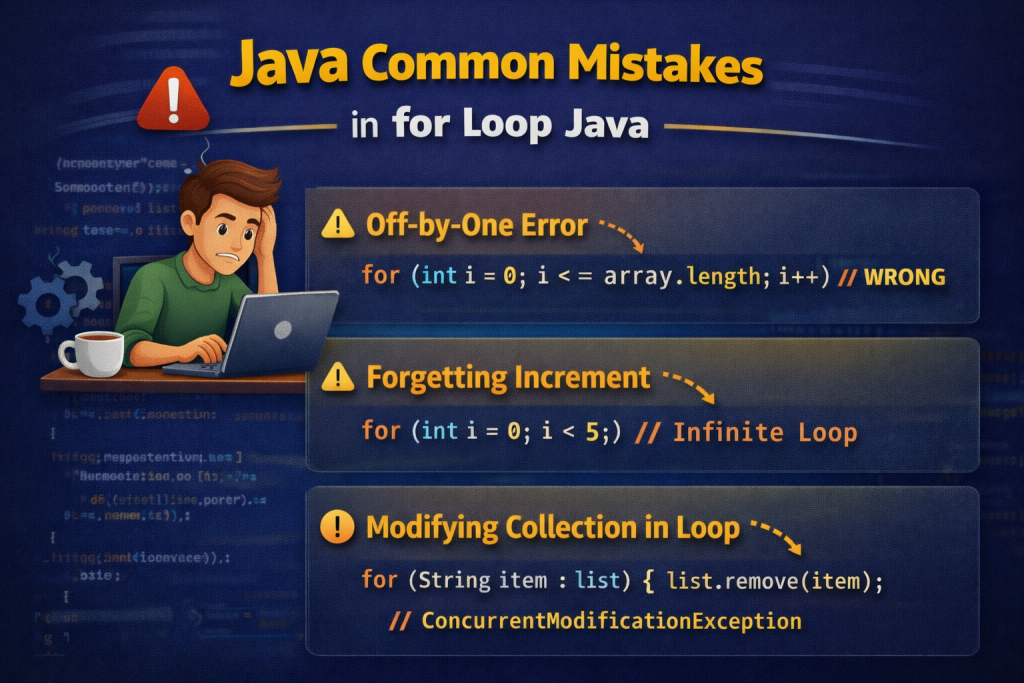
Java Common Mistakes in for Loop Java.
Off‑by‑one Error
for (int i = 0, i<=array.length, i) // WRONG.
Should be:
i < array.length
Forgetting Increment
for (int i = 0; i < 5;) // infinite loop
Alteration of Collection in the Loop (for loop java).
This brings about ConcurrentModificationException.
High Level Combination of All of them.
public productivity analyzer productivity analyzer.
main(String[] args) public static void main(String[] args)
employees = new String [ ] = ali, sara, John;
int[] tasks = {5, 8, 6};
for (int i = 0; i < employees.length; i++) {
System.out.println(employees[i] + ” worked on ” + tasks[i] + ” tasks completed by him or her);
}
int total = 0;
for (int i = 0; i < tasks.length; i++) {
total += tasks[i];
}
System.out.println( “Total Tasks: ” + total);
}
}
This integrates:
- for loop Java
- string length concepts
- productivity calculation
- server‑style logic
Conclusion
Java has the for loop which is among the most fundamental building blocks in the world of programming. It does both simple counting processes and complex server-side processes, providing you with a safe, well-organized method of executing repetitive logic processes. Whether you are employing looping over arrays, calculating lengths of strings, creating calculator applications, or moving data around in server methods you will have a concise control of the loop with the use of the for loop.
In this guide, we have observed the way the loop functions within the language, functions with arrays and strings, the ways a nested loop and an enhanced loop help investors and the way the loop is comparable with other concepts like sleep in JavaScript. We also examined the best practices in performance, errors in performance, and practical mistakes as well as real life examples that demonstrate how central the for loop is to the contemporary Java development process.
To master the for loop does not only imply having syntax knowledge but also being able to follow the logic and identify patterns of iteration as well as the ability to solve problems effectively. When properly used, it improves code readability, performance, and good maintainability. A good grasp of the for loop will always come in handy as you expand your number of applications or data analysis and server-side solutions, as well as to continually grow as a Java developer.
FAQs
What is the use of for loop in Java?
A for loop in Java is mainly used in order to run a piece of code several times depending on a definite condition. It can best be applied when the number of iterations is known in advance (as is the case with iteration through arrays, over lists, or the generation of repeated output). The for loop is a combination of initialization, condition check and increment/decrement into one structured statement and, therefore, the code is cleaner and easier to maintain. It is one of the most commonly used looping mechanisms of Java programming.
In which cases can I apply a for loop over a while loop in for loop java?
For loop is used when there is prior knowledge of the number of times the loop is to be used. As a simple example, a loop over 0 to 10, an operation on an array, which uses its size, or a counter based operation. A while loop is more suitable in cases where the number of times taken to complete a process is determined by a condition which varies over time and is not fixed in advance. Generally, when you are dealing with a counter based loop, the for loop in Java is the more readable and cleaner option.
What is the effect of Java string length within a loop in for loop java?
Java has a feature whereby the length method of the string gives the number of characters in a string. When it is called within a loop statement such as: i < str.length() it will make sure that the loop only executes once per character. This will enable you to retrieve every character without the index error that you would have gotten with charAt(i). A correct way of using the Java string length in a loop avoids out of bounds errors and the correct indexing of the length of the string.
Can a for loop run infinitely?
Yes, one can have an infinite for loop in case its condition is never met. This normally occurs in the absence of or when the increment or decrement statement is miswritten. As an example, when the loop condition is always true, and the counter is not changed, the loop will not stop running. Infinite loops are occasionally even explicitly configured in server monitoring systems or background services though they must always have a safe exit point to prevent application crashing.
What is a for loop that is enhanced in Java?
The for-each loop or the enhanced for loop is the simplified version of the conventional for loop. It is applied specifically when the iteration over (arrays or collections) is required without the use of an index variable. The loop itself in turn gives out each element separately instead of manually retrieving their elements according to index. This enhances the legibility and minimizes the error possibility of Index. Nevertheless, it cannot be used in situations when you have to alter the elements based on their index or get their position.
What about a for loop in a Java server method?
A for loop may be commonly used in server-side Java code within a method when multiple records are to be processed, user requests are handled, results in a database are iterated over, or a dynamically-written response is required. As an illustration, when a server is accessing a list of users in a database, then a loop can be used to access one user in the database. The server logic is frequently developed to make use of loops to handle bulk operations. Loops are also necessary because without them it would be a necessity to duplicate code that does repetitive tasks on a server.
JavaScript sleep vs. Java sleep What is the difference between Java sleep and JavaScript sleep?
Java and JavaScript do not deal with delays in the same way. The sleep method that is called in Java is the Thread.sleep(milliseconds) method and it stops the thread that is running at a particular time. JavaScript however lacks an inbuilt sleep() command. Rather, it relies on such functions as setTimingOut or Promises in order to delay the execution. The point of difference is that the sleep method of Java blocks a thread where delay functions of Javascript are not blocking and asynchronous. This difference should be understood when operating in a backend (Java) and frontend (JavaScript) setting.
What is the use of a for loop to calculate totals?
You usually declare a variable (e.g. int total = 0;) prior to the beginning of the loop to make the totals calculations in Java. You add every value, within the loop, to the total variable. This method is usually applied to the situations like the construction of a productivity calculator, the addition of sales data, the calculation of averages or the work with numeric arrays. The loop helps in making sure that all the elements are incorporated in the calculation in a systematic and efficient way.
What is a nested for loop in for loop java?
A nested for loop is a loop within the other loop. Each time the outer loop is repeated the inner loop is run through in its entirety. Nested loops are typically applied when you are dealing with arrays of data (two dimensional arrays (matrices)) or creating patterns, having to process data in a table or comparing data in two datasets. Nested loops should however be used sparingly by developers since they may have an impact on performance in case of large dataset and time complexity.
Does a for loop perform better than a while loop?
Performance wise there is usually no huge distinction between the use of a for loop and a while loop in Java. They both assemble into similar code and run at almost the same speed. The choice between the two must be made on the basis of legibility and logicality as opposed to the speed. In the event that the loop relies on a counter and a definite point to start and finish, then the for loop in Java typically gets the improvements of being better structured and maintained.