
Is cyber security hard?
The question ‘is cyber security hard’ is becoming increasingly common as technology continues to shape modern life. Many people ask’ is cyber security hard’ because they see news about hacking, data breaches, and online threats. In reality, when we ask is cyber security hard, the answer depends on the learner’s background, interest, and consistency.
The concept of cyber security has turned out to be an extensive and urgent topic in the area of information technology in the current digital and connected world. Since people, organizations, and institutions continue to rely on internet-based systems, online services, and networked infrastructure, many beginners naturally wonder is cyber security hard to understand at the beginning.
Security has become not only a technical issue but also an economic stability, privacy, and trust issue in organizations because of cyber attacks, data breaches, and other types of digital exploitation. Because of this, the concern is cyber security hard to learn is now relevant for students, professionals, and career changers.
With this increased dependence on technology, the question that comes to the mind of many individuals, especially beginners, is cyber security difficult or approachable, or in simple terms, is cyber security hard for someone starting from zero?
Although some of the elements of cyber security may be complex and demand technical skills, the field has been well designed in a manner that the beginners can make gradual developments. As a result, when asked about the issue of cyber security being challenging, the sensible answer to the question is that with time and practice, a person can get better.
Those people with no previous experience in technologies can still create a strong basis through positive attitude, routine training and the use of the right educational materials. Therefore, addressing the challenge of cyber security, it is crucial to admit that the complexity is mitigated with the help of a systematic learning pathway.
This guide operates as a general literature that aims to shed light on the question of whether cyber security is a challenging field, to demarcate the key concepts and also describe career opportunities existing in the field.

The Concept of Cyber Security and Its Knowledge
Cyber security is the practice of protecting systems, networks, devices, and data against unauthorized access, attacks, or destruction. Many beginners first ask is cyber security hard because the field includes both technical and non-technical controls.
Cyber security may seem complicated to amateurs due to its wide technological and threat coverage. However, when learners explore the basics, they often realize that the question is cyber security hard becomes less intimidating.
Like any discipline, cyber security has simple principles that may be acquired gradually. This is why experts often respond to the question is cyber security hard by saying that the fundamentals are manageable.
Is It a Challenge for Newcomers?
Cyber security is often believed to be difficult since people associate it with sophisticated hacking and complicated attacks. This perception strengthens the belief that is cyber security hard must always be answered “yes,” but that is not always accurate.
Newcomers do not need to know everything at the beginning. In fact, many professionals who once wondered is cyber security hard started with networking basics and operating systems.
Technology changes rapidly, and threats evolve quickly, which sometimes reinforces the perception that is cyber security hard because there is always something new to learn.
So, is cyber security hard? It can feel challenging without a technical background, but it is not impossible. Most learners who first asked is cyber security hard discover that practice makes concepts clearer over time.
Five General Types of Cyber Security
Understanding the core areas helps answer the question is cyber security hard by breaking the field into manageable sections.
Network Security
Network security protects computer networks from attacks. Many beginners who ask is cyber security hard find networking easier once they understand IP addresses, routers, and firewalls.
Application Security
Application security focuses on secure coding, testing, and updates. Learning these basics helps clarify why is cyber security hard is often a misconception rather than reality.
Information Security
Information security ensures confidentiality, integrity, and availability of data. Understanding these principles helps learners see that is cyber security hard does not mean it is impossible.
Operational Security
Operational security includes policies, access controls, and permissions. These non-technical aspects also help answer the question is cyber security hard, since not all roles require deep programming.
Cloud Security
Cloud security protects cloud-based services and storage. As organizations move to the cloud, more learners are asking is cyber security hard in cloud environments, and the answer again depends on training and practice.
Networking and Cyber Security
Networking skills are essential in cyber security. Communication security depends on IP addresses, routing, and protocols. Many learners who initially asked is cyber security hard find networking one of the most logical starting points.
Network environments are often targeted by cyber attacks, which explains why those who research is cyber security hard are encouraged to study networking fundamentals early.
Malware and Threat Awareness
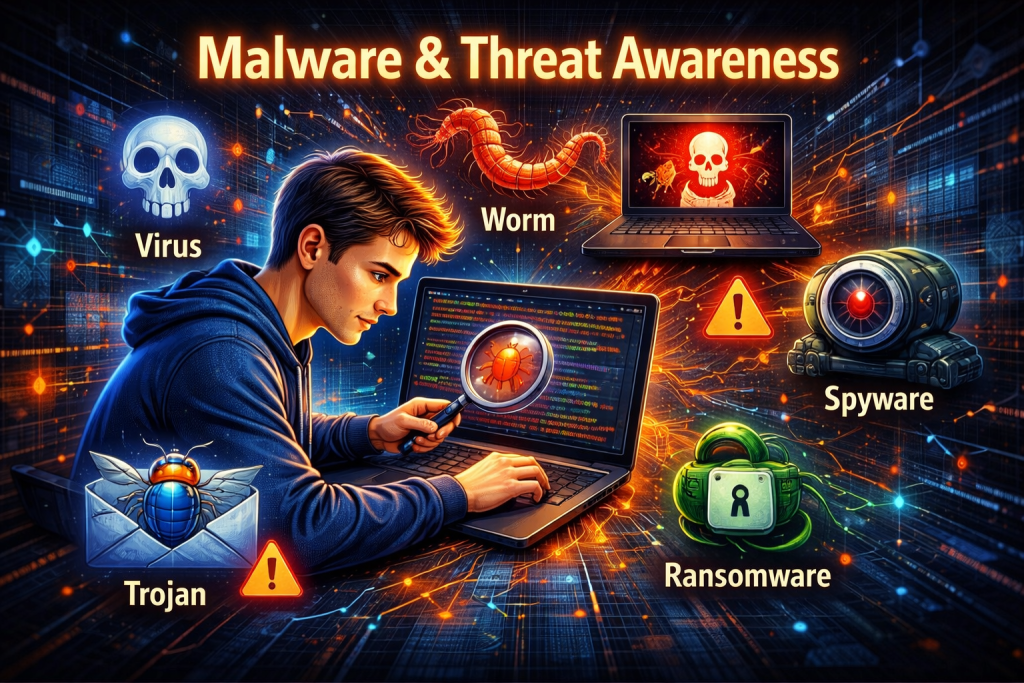
Malware such as viruses, worms, ransomware, spyware, and trojans pose significant threats. Hearing about advanced malware sometimes makes beginners feel is cyber security hard must be true.
However, beginners only need to understand basic malware behavior at first. Learning step by step helps reduce the fear associated with the question is cyber security hard.
Human Factors and Security Awareness
Cyber security involves human behavior as well as technical systems. Policies, awareness training, and ethical conduct all play roles in preventing breaches. This often surprises people who think the answer to is cyber security hard depends only on programming.
Understanding human factors shows that cyber security includes communication, analysis, and decision-making skills, which helps reframe the question is cyber security hard in a more realistic way.
Skills Needed in Cyber Security
Many novices believe cyber security requires genius-level ability. This assumption strengthens the perception that is cyber security hard must be answered positively | solo et
In reality, important skills include:
- Critical thinking
- Problem-solving
- Basic networking knowledge
- Attention to detail
- Continuous learning
Programming is useful but not mandatory at the beginning, which helps clarify why is cyber security hard is often misunderstood.
Learning Curve and Career Growth
The learning curve is one factor influencing whether someone feels is cyber security hard. Entry-level roles such as IT support, security technician, or network assistant help beginners gain experience.
Certifications, online courses, and labs make learning structured and practical. Many professionals who once asked is cyber security hard eventually find the field rewarding.
Common Myths About Cyber Security
Cyber security may appear challenging due to misconceptions:
- You must be a hacker
- You must be strong in mathematics
- Only experts can enter the field
Removing these myths helps people better evaluate is cyber security hard without unnecessary fear.

Worth Cyber Security the Trouble?
Rewards are numerous and they may include high demand, career advancement, salary and meaningful work. The issue of whether cyber security is hard or not is not so critical to many professionals after they realize the pros of the profession.
Conclusion
So, is cyber security hard? The straight forward response is that it will take hard work, systematic learning, and practice. Novices who used to question the question of whether cyber security is difficult will mostly find out that with patience and inquisitiveness; the process is not as difficult as it might have seemed.
There is no thing like knowing it all in cyber security. It concerns the slow learning, adjusting and gradual enhancement. The first person to pose the question whether cyber security is hard has to keep in mind that all experts were beginners.
FAQ ( Frequently asked Qs )
1. Does a new person in the field find cyber security challenging?
Cybersecurity may seem overwhelming initially, at least to people who are not tech-savvy. The most widely used entry points include understanding the functionality of networks and understanding some fundamental security concepts. The subject becomes a lot easier to grasp with the continued study and practice.
2. What are the main spheres of cyber security that I am expected to know about?
Typically, cybersecurity involves five categories, which are network security, application security, information security, operational security and cloud security. The identification of these areas makes beginners feel that the field is not only broad but it is also structured.
3. And why has it been stated that networking knowledge is applicable in cyber security?
The knowledge in networking is a must as most network attacks go across networks. To secure a local area network such as one in a school or office, one needs to have some knowledge of how the devices work together and communicate with each other. With such basics, you will be able to protect the network in a better way.
4. What is nebula malware, and do amateurs care about it?
The malware is called Nebula malware, which is an advanced form of malicious software installed in the background and has the power to damage or steal data. Beginners do not have to be concerned about its details at the moment, however, they should be aware that these threats exist, which is why cybersecurity matters.
5. What do we simply mean by a cyber background check?
The cyber background check is an online investigation of the activities carried out by a person to establish whether he is a security threat or not. It shows that cybersecurity is not only a technology issue but also an issue of personal accountability when discussing the use of digital tools.
6. Is it necessary to be a programmer in order to begin undergoing cyber security training?
At the entry level, there is no need to be a programmer. The basics concepts focus on networking, operating systems, and concepts of basic security. Simple scripts, such as Python, Bash, could be learned, and be helpful in automation and analysis.
7. What is the time frame to gain the rudiments of cyber security?
Time is dependent on commitment and experience. Within several months, a beginner can learn the basics of networking, threats, simple practices, etc. Complete mastery is however achieved through constant hands on training and exposure to reality.
8. How can new users learn to be more cyber security friendly?
Novices are to begin with online labs, virtual machines as well as ethical-hacking sites. A small home lab, obtaining a personal PC, and evaluating actual attack scenes are viable ways of getting experience.
9. Is it a good career decision to work in cyber security in the future?
Yes. Cyber security is a solid developmental opportunity- companies all over the world require people to secure data and systems. The digital transformation is increasing with demand for trained security experts, which is expected to be on top.
10. What is the best habit that a person studying cyber security has?
Continuous learning is key. Both threats and technologies change fast, it is imperative to keep up with them through security news, exercise and update tools and techniques to achieve success over time.